
33. Neverland
When the Eighth Doctor faces the impossible, Big Finish delivers one of its boldest ever cliffhangers.

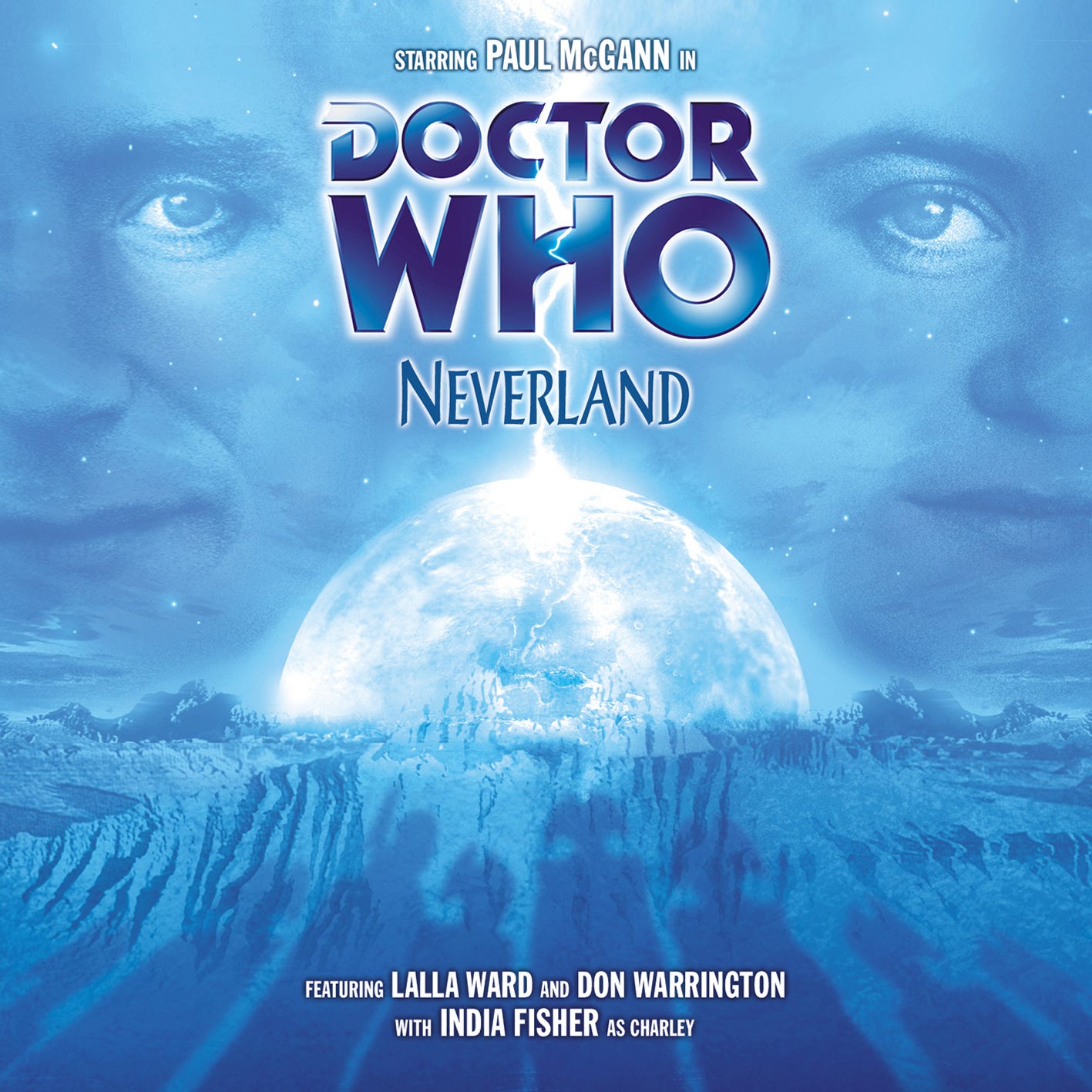
If there’s one thing Doctor Who has always asked of its audience, it’s faith. Faith in the improbable. Faith in the kind-hearted stranger. Faith that doing the right thing, even when it breaks the rules, will still matter in the end. But what happens when that faith falters? When the impossible act of mercy puts everything at risk? Neverland opens with that question, and by the end, it’s shaken the very foundations of the Doctor’s world. This is no ordinary finale. It’s a reckoning, and it hits like prophecy.
The story picks up immediately after The Time of the Daleks, and there’s barely time to draw breath before the Doctor and Charley are seized by the Time Lords and hauled back to Gallifrey. Why? Because the universe is unravelling. Anti-time outbreaks are spreading like wildfire, the timelines are splintering, and the Web of Time (Doctor Who’s equivalent of the internet, only moodier) is coming apart. The root cause? A single act of kindness: the Doctor saving Charley from her death aboard the R101. And now Romana, returning to the fold in full Presidential mode, wants answers. Accountability. A solution. Preferably one that doesn’t involve the total collapse of reality. Simple stuff.
What follows is a desperate voyage into the Anti-Time Universe, a bleak mirror of our own where logic dissolves and paradox reigns. And it’s here that Neverland begins to show what its made of, not just as a high-concept sci-fi romp, but as a story willing to question everything the series holds dear. The Doctor isn’t framed as a swashbuckling hero, but rather as a dangerously sentimental man whose refusal to accept a fixed point in time may have doomed creation itself. It’s the kind of indictment you rarely see in classic Doctor Who, and the script leans into it with conviction. This isn’t just a story about universal peril. It’s about the cost of doing the right thing when the right thing breaks the rules.
Alan Barnes’s script pulls double duty here: it’s both a season finale tying together threads from Storm Warning onwards and a sweeping Gallifreyan epic in its own right. Structured in two extended episodes rather than four traditional ones, it gives itself space to breathe… and bellow. The story is awash with mythological references: Zagreus, anti-time, the creation of the Time Lords, the legacy of Rassilon. It’s proper lore-heavy stuff, but it never quite collapses under its own weight. You don’t need a PhD in Gallifreyan Studies to follow it, though it helps if you’ve been paying attention. And it’s to the script’s credit that, despite the technobabble and continuity fireworks, the writing rarely loses clarity—there’s grandeur and momentum here, but also control.
What’s most impressive, perhaps, is that Neverland manages to turn Doctor Who into a kind of dark fairytale without mythologising its leads beyond recognition. Yes, the story places them at the centre of the universe, but it never forgets who they are: two people, running from the consequences of a single decision. The Doctor can’t bring himself to lose Charley and its his guilt, his stubbornness, his need to believe he can save everyone which all play a part in the growing catastrophe.
But Charley’s had enough of running. She wants agency. She wants to choose. There’s something deeply poignant in the way she confronts her own fate… and something achingly apt in how she becomes Wendy to the Doctor’s Peter Pan, the one growing up while he’s still chasing stars.
Paul McGann and India Fisher are, frankly, extraordinary. Both are firing on all cylinders, their performances full of urgency and emotional weight. McGann’s Doctor has always danced on the edge between boyish wonder and unbearable sorrow, and here he finally slips. That final scene—“I have become Zagreus”—remains one of the most audacious cliffhangers in Doctor Who history, chilling precisely because you feel how close to the edge he’s been the whole time. And Fisher? Well, she makes a very convincing case for best Big Finish companion. I know my heart belongs to Evelyn Smythe (Maggie Stables forever), but Fisher’s work here is so layered, so charged with feeling, that I start to waver. She handles her dual role with elegance and absolute control, anchoring the story emotionally even as the universe threatens to fall apart.
Lalla Ward’s Romana is another standout, her calm pragmatism grounding a story that could easily spiral off into its own bombast. There’s steel beneath the silk, and you get the sense that she’s the only adult in the room—which feels right, considering the way the Doctor often behaves when the stakes are personal. And she delivers one of the best lines in the whole script: “He can’t help himself. He cares.”
The production is sublime. Alistair Lock’s sound design paints an immense cosmic canvas without ever drowning the story’s more intimate beats. The soundscape evokes the scale of the Anti-Time Universe with fizzing distortion, disintegrating echoes, and eerie silences that are somehow louder than any explosion. The score is lush and ominous, and the editing keeps everything tight even as the story gallops towards metaphysical meltdown. It feels enormous—too big for audio, in some ways—but the imagination does the rest.
And then there are the Neverpeople: vengeful, broken echoes of erased timelines. They haunt the story’s edges like ghosts in a machine, desperate to exist again. There’s a melancholy horror to them—part folk tale, part existential scream—and they lend the whole story an eerie, almost gothic atmosphere.
And that’s the thing. Neverland may be vast and mythic and dripping in lore, but at heart, it’s a ghost story. A reckoning. It draws a line under everything that came before, pays it off with flair, and then kicks the floor out from under you with one whispered nursery rhyme. The faith has been shaken. The story has changed. The next chapter will be darker. And oh yes… we’re going there.
Because Zagreus sleeps inside your head. Zagreus lives among the dead.
And the fairytale is just beginning to fracture.
I listened to Neverland over two days in Helsinki, where Dom and I arrived after an overnight ferry from Stockholm—and where we were lucky enough to attend Helsinki Pride, which, unexpectedly, became my favourite of the year. No glittery headliners. No float sponsored by a bank. Just people: queer people, allies, families. Together. Visible. Loud in our silence and quiet in our defiance. It reminded me that Pride is, and must always be, protest. And so, here, hearing the Doctor rage against inevitability and Charley step into her own fate, the story’s call for courage and accountability means more to me than ever.
Faith, after all, means more when the world wants to take it away from you. And Neverland—like Pride—is a reminder that stories still matter.
They matter because we do.
Quick Take
There are Doctor Who stories that simply entertain, and there are stories that stop you in your tracks. Neverland is the latter. Paul McGann and India Fisher take the Eighth Doctor and Charley to places that feel raw, dangerous, and utterly unforgettable. The atmosphere is thick with tension, the stakes are higher than ever, and the emotional punches land with full force.
It’s a story that isn’t afraid to test both its characters and its audience, rewarding those who are willing to listen closely. At its heart, Neverland is about courage, consequence, and how even the smallest act of faith can change everything. If you’ve been waiting for Big Finish to prove just how audacious Doctor Who on audio can be, this is the one.