
50. Zagreus
The story too big, too loud, and too weird to ignore

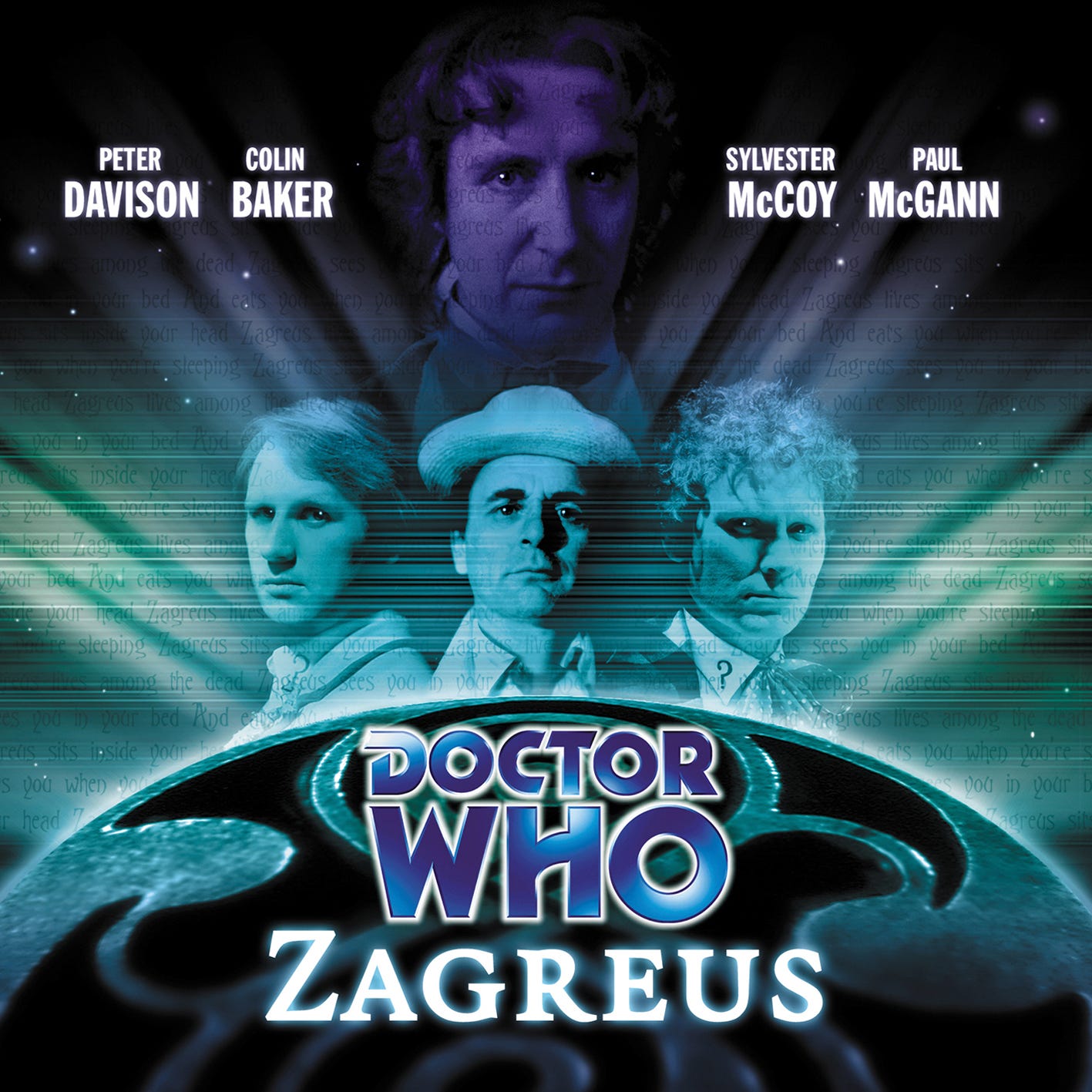
Quick Take (no spoilers)
Zagreus isn’t just a Big Finish anniversary story: it’s a full-blown anti-time hallucination. It throws everything at the wall - surreal settings, familiar voices doing unfamiliar things, and enough ambition to power a whole season. It’s messy, overwhelming, occasionally brilliant, and very easy to bounce off if you’re not prepared for its sheer… intensity.
And yet, there’s something hypnotic about it. Beneath the noise and the weirdness are moments that sparkle with genuine imagination and emotional punch. You might not love it, but you definitely won’t forget it. And if you want to know why this chaotic experiment still matters — well, that’s where the full review comes in…

Long Take (with spoilers)
There’s a fine line between ambition and indulgence, and Zagreus doesn’t so much walk it as leap over it while shouting in rhyme.
The thing is… it didn’t have to be like this. For the 40th anniversary, Big Finish could have just given us The Four Doctors, let everyone beam fondly at each other for an hour, and called it a day. But no. They went all in and gave us three-plus hours of material, every actor they could find, a plot that eats itself alive, and enough Lewis Carroll references to make an English teacher twitch.
Zagreus isn’t a story so much as an event. A fever dream. A dare. And yet… they tried. Zagreus is a monument to ambition: a sprawling, unfiltered attempt to create something worthy of Doctor Who’s anniversary at a time when the TV series was still a glint in Russell T Davies’ eye. Picking up straight from Neverland, the Doctor’s been possessed by Zagreus, a mythical anti-time boogeyman connected to the Eye of Harmony. Charley’s trapped in a TARDIS that’s turning against her, the Doctor’s sanity is slipping away, and the walls of reality are melting faster than the plot can keep up. It’s Alice in Wonderland meets Gallifrey: a cosmic identity crisis sprinkled with poetry, philosophy, and continuity references thick enough to drown in.
And yet… this is all very deliberate. I’ve mentioned previously that the seeds for Zagreus were planted as far back as Project: Twilight, and the cliffhanger this story resolves was a whole sixteen stories ago when Neverland ended with that gut-punch of ‘I am become Zagreus’. So, way back in 2003 when this was released, it’s not inaccurate to say that I, along with many other fans, were in the mood for something grand. What we got was indeed grand… but in about the same way the London Underground map is grand: intricate, impressive, but overwhelming if you stare too long. And, in my case, on this relisten it was literally overwhelming. I was listening after long days in London, occasionally nodding off on the Tube, and after a weekend seeing the Oasis reunion at Wembley and so this was another temporary stall in the marathon: there were days when I genuinely couldn’t face another round of anti-time exposition. Zagreus is not a casual listen. It’s a full-time job.
Structurally, though, it’s clever. Charley drifts through surreal recreations of time and space, meeting familiar voices in unfamiliar guises. Each act draws from a different “Doctor era”: Peter Davison and his companions in one, Colin Baker and his in another, Sylvester McCoy and his in the third. It’s a brilliant conceit on paper with each section paying homage to a different corner of the show’s history, wrapped in dream logic. The problem? Nobody’s actually playing themselves. For a 40th-anniversary extravaganza featuring every living Doctor and companion actor on the Big Finish roster, only Lalla Ward and Louise Jameson get to be their actual characters. (And Leela’s swiftly possessed by Rassilon, so our favourite savage barely lasts six minutes.).
You can see the logic: it’s meant to be disorienting, a fractured reflection of the Doctor’s mind. But it’s also, let’s be honest, a bit of a cheat. We wanted the Doctors, plural, sparring and saving the universe together. Instead, we got the same actors in elaborate hats doing impressions of people we’ve never met.
And yet the cast, bless them all, give it everything. Paul McGann wrestles heroically with the material, torn between the Doctor and Zagreus in a constant tug of war. His booming anti-time voice sounds like he’s gargling gravel through a vocoder, but he finds moments of real despair and fury that cut through the messy dialogue. India Fisher is the beating heart of the whole thing; Charley’s confusion, heartbreak, and stubborn loyalty kept me tethered when everything else is floating away.
Colin Baker, meanwhile, is a riot, especially in his vampiric Time Lord sequence, where he chews the scenery with gusto and clearly loves every second. Maggie Stables brings warmth and authority, Sylvester McCoy slips between whimsy and menace with ease, and Peter Davison radiates quiet melancholy. Even the cameos add to that strange sense of reverent chaos: the Brigadier as a disembodied mentor, K-9 popping up for reasons known only to the Matrix, and a flurry of familiar voices you’ll swear you recognise before they vanish again. And then there’s Don Warrington as Rassilon being smooth, sinister and the sort of presence that makes you wish he’d narrate your nightmares. It’s one of the story’s few unambiguous triumphs.
And yet, for all its flourishes, Zagreus struggles to maintain focus. Whole stretches feel like being trapped in a particularly intense university lecture delivered by a professor who’s forgotten what question they were answering. Part One drags terribly with whole monologues about anti-time and identity that feel like déjà vu before you’ve even finished hearing them. The story keeps re-explaining itself, as though it doesn’t quite trust you to keep up. By the midpoint, I really wasn’t sure if I’d been listening for two hours or two centuries.
Still, once it finally starts to coalesce (about two and a half hours in, mind you), there are flashes of brilliance. The reveal that Rassilon isn’t Gallifrey’s noble founder but a manipulative tyrant terrified of change is genuinely striking. His attempt to weaponise the Doctor in order to turn him into the ultimate enforcer of his static vision of time lands with real mythic weight. I could feel the story straining for greatness here, reaching for something profound about power and fear and self-delusion. For once, it almost gets there.
The subplot of the TARDIS turning against the Doctor was divisive in 2003, but in hindsight, it works surprisingly well. It’s not the TARDIS herself being cruel: it’s her anti-time-corrupted reflection, all her doubts and frustrations magnified and weaponised. It’s oddly moving to hear that relationship break down; when she saves him in the end by literally giving him part of her heart, it lands with real tenderness. Amid all the cosmic chaos, this strange love story between a man and his ship provides the emotional clarity the rest of the play sometimes forgets to find. It’s also, looking back, remarkably prescient. Years before Nu Who would make the Doctor’s relationship with the TARDIS explicitly romantic, before The Doctor’s Wife would literalise what Zagreus only implies, this story treats their bond as something profound and mutual. She’s not just a vehicle; she’s a partner who can be hurt, who can doubt, who ultimately chooses him. For 2003, in an era when Doctor Who was still supposed to be about running down corridors, that’s quietly radical.
Because here’s the rub: when it works, Zagreus is astonishingly good: the foundry scenes, the Edwardian streets, the eerie hum of anti-time itself are all fantastic ideas executed brilliantly. But when it doesn’t, it’s a sonic migraine. There are moments when the sound design feels like someone’s set fire to the mixing desk… and that static screeching in Part Two remains one of Big Finish’s great mysteries, and not in a good way. You can hear what they were going for: sensory overload to match the Doctor’s fractured mind. But there’s a difference between disorienting and genuinely unpleasant, and Zagreus occasionally mistakes one for the other.
The score’s ambition, however, is admirable: opening and closing each part with different versions of the Doctor Who theme is clever, until Part Three loops back to the original again for no reason whatsoever. It’s the sort of inconsistency that sums up the whole production: brilliant ideas, half-executed.
And yet… despite everything, it’s hard not to admire it. There’s a sincerity here that you can’t fake. Unlike the convoluted spectacle of Flux or the meta gymnastics of Moffat’s later years, Zagreus genuinely believes in its own importance. It wants to be mythic, to say something about the Doctor’s identity and guilt and the cost of being the universe’s moral compass. It just never quite finds the sentence. But that earnestness, combined with sheer audacity, makes it impossible to dismiss. This isn’t a cynical anniversary cash-in; it’s a group of fans, now professionals, throwing every toy they own into the air to see what happens.
When the dust finally settles and we reach Gallifrey, the pieces begin (sort of) to align. Rassilon’s plan collapses, Charley saves the Doctor, and the Divergent Universe arc is set in motion. It’s an ending that feels like both a reward and a dare: “Congratulations on surviving. Now strap in for something even stranger.” Credit where it’s due: the ambition’s huge. But the Divergent saga never quite cashes the cheque Zagreus writes. All that talk of new universes and strange new lifeforms fades fast, to be replaced by what we actually get in the upcoming stories by perfectly normal adventures minus the Daleks. The epic showdown with the Divergents we’re promised here? Never happens.
Now, does that undercut Zagreus itself? Honestly… not really. The story works (inasmuch as it works at all) as a rupture point, a deliberate shattering of everything the Eighth Doctor audios had built. Whether the pieces get reassembled properly later matters less than the fact that Big Finish was willing to smash the formula in the first place. Still, there’s a faint disappointment knowing all this sound and fury sets up a whimper rather than a bang.
That is, however, an argument for another day because, listening now, Zagreus feels like a time capsule from an era when Doctor Who lived entirely in the imagination, kept alive by people who loved it too much to let it fade. It’s the last gasp of Big Finish’s first era of the Eighth Doctor, and it almost bursts from the weight of everything it’s trying to do. It’s indulgent, self-referential, and occasionally incomprehensible, but it’s also brimming with heart and creativity. It’s the Doctor Who equivalent of a prog-rock concept album: twenty minutes too long, filled with soliloquies no one asked for, but made with such passion you can’t help but admire it.
Zagreus is a bit punk: part fever dream, part London Underground map drawn in anti-time ink. It’s murky, messy, occasionally brilliant… and exhausting. But if you stick with it, there are flashes of almost-brilliance there. I can’t quite say I loved it, but I couldn’t quite look away either. It’s too long, too talky, and far too pleased with itself… but also utterly sincere, gloriously ambitious, and defiantly alive.
So, yeah… it really didn’t have to be like this.
But it is.
And, when I look at the glorious mess that has just celebrated the 60th anniversary… thank Rassilon for that.